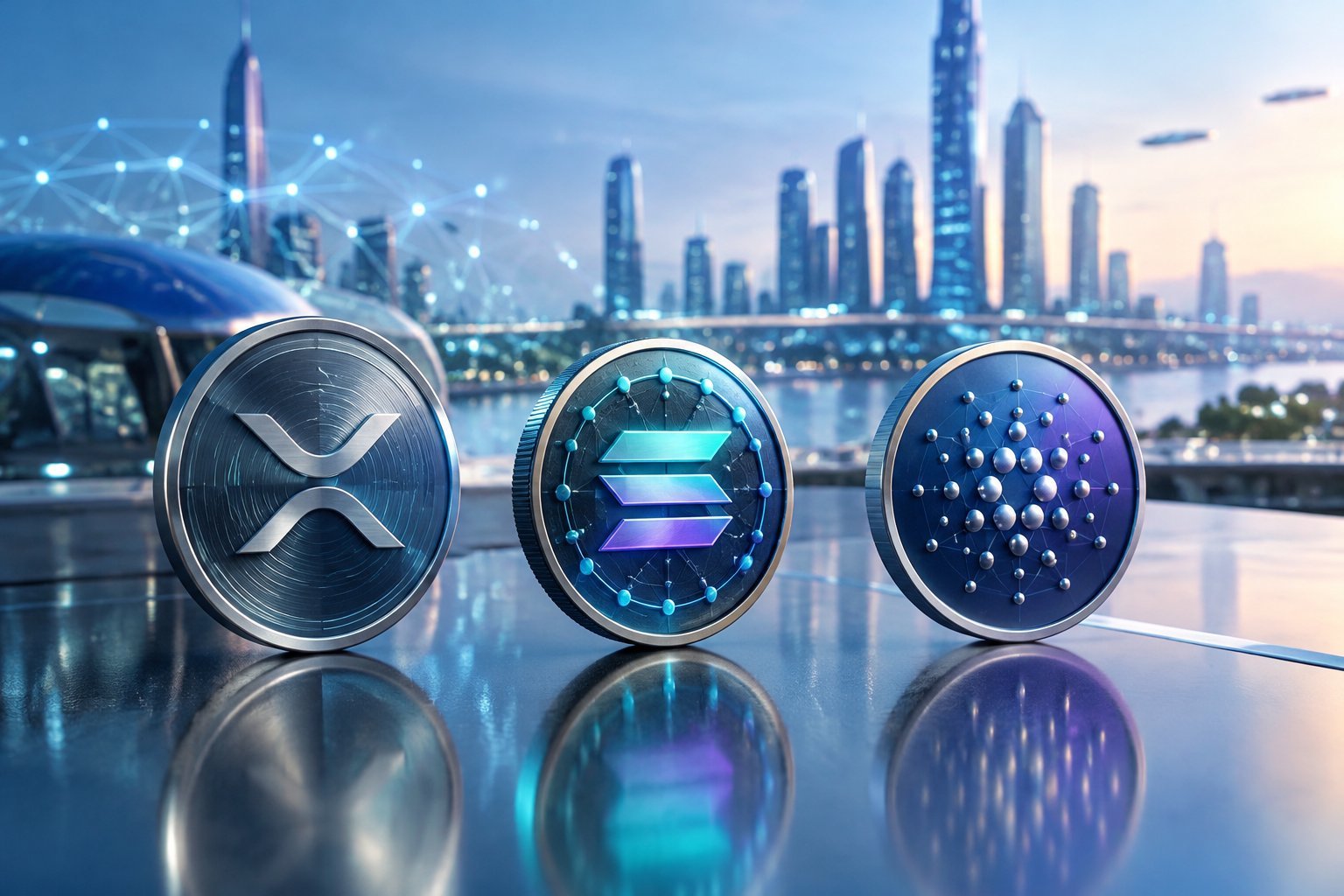
For XRP, Solana, and Cardano in 2027, Solana has the broadest application-growth case, XRP has a payments-focused thesis, and Cardano’s prospects hinge on expanding its smart-contract ecosystem. Your comparison should focus on durable network use and the extent to which activity creates demand for each token, since market narratives alone do not establish lasting value.
You can use those differences to match each asset to a distinct investment thesis. Treat any 2027 price target as a speculative scenario: adoption, regulation, liquidity, and broad crypto-market conditions can all change the outcome.
How Should Investors Compare These Three Networks?
You should compare the networks by examining what people use them for, whether activity is growing, and how that activity connects to each token. A busy blockchain does not automatically produce proportionate token value if fees are low or usage is driven by short-lived incentives.

| Criterion | XRP Ledger | Solana | Cardano |
|---|---|---|---|
| Core investment thesis | Payments and settlement | High-throughput applications | Research-led smart contracts |
| Activity to watch | Payments and XRPL applications | App use, fees, and liquidity | DeFi, applications, and governance |
| Token value connection | Ledger fees and liquidity | Fees, staking, and app demand | Fees, staking, and network demand |
Real-World Utility and User Demand
Your first test is whether a network solves a recurring problem for users. XRP’s thesis centers on moving value and supporting payment-related activity. Solana competes for users across a wider range of applications, including trading, consumer products, and emerging payment use cases. Cardano’s investment case relies on developers and users building sustained activity across its smart-contract ecosystem.
Look for activity that persists beyond a market rally. Payment volume, returning users, application transactions, and liquidity can help you distinguish practical demand from attention driven mainly by token prices.
Developer, DeFi, and App Activity
Developer participation helps determine whether a network can keep producing useful applications. You can track deployed apps, user activity, liquidity, and whether projects retain users after incentives or promotional campaigns change.
Solana’s broader app activity gives it multiple routes to growth, while Cardano’s progress depends on more projects attracting users and capital. XRP Ledger activity should be assessed through payment-related use as well as any growth in applications built on the ledger. Network activity matters to your analysis when it reflects use that can be sustained.
Token Economics and Value Capture
Token economics shape how network usage may connect to an asset’s demand. Solana and Cardano use staking as part of their network models, while XRP’s role is tied to ledger transactions and liquidity. For each asset, examine issuance, staking rewards where applicable, fee design, and the amount of tokens entering circulation.
A rise in transactions alone does not guarantee a matching increase in token value. You should ask whether users need the token to access the network, whether fees create persistent demand, and how new supply or token distribution affects holders.
What Could Drive XRP’s 2027 Outlook?
XRP’s 2027 outlook depends on whether payment-related use and institutional access translate into lasting demand for the asset. Your key tests are real transaction activity, liquidity, and whether ledger development creates practical reasons to use XRP.

Payments and Institutional Access
XRP’s payments thesis centers on using a digital asset to move value across markets and support liquidity. For your assessment, separate the growth of payment services from demand for XRP itself: a payment product can expand without every transaction requiring the token.
Institutional access could broaden through regulated investment products and derivatives. ETF access and CME Group crypto derivatives are among the channels shaping institutional crypto participation. You should still distinguish access from adoption: financial products can make exposure easier to obtain, while sustained demand depends on investor interest and the asset’s use.
XRP Ledger Upgrades and Regulatory Clarity
Ledger upgrades could strengthen XRP’s case if they support useful applications and improve the network’s appeal to businesses and developers. Watch for delivered features, adoption after launch, and transaction activity that continues beyond initial announcements.
Regulatory clarity in the United States can also influence exchange access and institutional appetite. Consider whether policy developments create durable operating conditions for XRP-related activity, then compare those changes with measurable use of the ledger. Headlines and proposed plans provide context, while implemented changes and user demand provide stronger evidence.
Where Could Solana and Cardano Find Growth?
Solana’s growth case rests on a broad application ecosystem and its ability to handle activity at scale, while Cardano’s depends on attracting more developers, users, and capital. For both networks, adoption needs to show up in persistent use, not just a rising token price.
Solana’s Speed, Applications, and AI-Agent Payments
Solana’s appeal comes from its capacity to support many kinds of applications, including trading and consumer-facing services. If you are evaluating its 2027 potential, examine application activity, liquidity, network reliability, and whether users return after market incentives fade.
AI-agent payments are another emerging use case. Cardano has joined Solana and XRP Ledger in the race to support AI-agent payments. For Solana, that theme could create an additional source of activity if developers build systems that use the network and users adopt them. Treat early announcements as a catalyst to monitor, not proof of future transaction demand.
Cardano’s Ecosystem Development and Adoption
Cardano’s growth depends on the breadth and usefulness of applications built on its smart-contract platform. You can monitor developer activity, DeFi liquidity, user retention, and whether new projects bring distinct use cases to the network.
Cardano’s research-led development approach may appeal to investors who value deliberate protocol design. Its market potential still relies on execution: upgrades need to support applications that attract users and capital. Track shipped improvements and resulting ecosystem activity to judge whether development is translating into adoption.
Which Catalysts Could Change Their Relative Potential?
The ranking among these assets could shift as network activity, U.S. regulation, and institutional demand evolve. You should weigh catalysts by their measurable effects on adoption and token demand, not by how prominently they feature in market discussion.
Protocol Progress and Network Activity
Protocol upgrades can improve a network’s capacity or expand what developers can build. Their investment significance becomes clearer when you see follow-through in usage, fees, liquidity, and active applications. A roadmap announcement alone offers limited evidence about eventual adoption.
Compare activity across time and through different market conditions. A network that retains users and applications during quieter periods may show a stronger foundation than one whose activity rises only during speculative surges.
Regulation, Institutional Demand, and the Macro Backdrop
U.S. regulatory policy can affect exchange access, institutional participation, and the willingness of businesses to build on crypto networks. Institutional demand can also grow through investment products and derivatives, though access does not guarantee strong inflows or lasting use.
Macro conditions influence the whole market. Interest rates, liquidity, and investor appetite for risk can amplify gains or deepen losses across XRP, Solana, and Cardano. When comparing their outlooks, separate broad market momentum from network-specific progress.
How Could Risks Change the Outlook?
Your 2027 assessment should account for execution, competition, token supply, and the volatility of crypto markets. Any one of these factors can weaken an investment thesis even when a network has promising technology or a compelling use case.
Execution and Adoption Risks
A planned upgrade or application creates value only if it is delivered and attracts sustained use. Delays, technical problems, weak user retention, or limited developer interest can slow adoption. You should follow what has launched and how people use it, rather than treating a roadmap as a completed result.
Adoption also depends on whether a network’s services solve real problems for users and businesses. Payment activity, DeFi participation, and consumer applications each face different barriers. A strong narrative can draw attention, while repeated use is a more useful signal of demand.
Competition, Token Supply, and Market Volatility
Each network competes with other blockchains and established financial services for developers, users, and liquidity. A rival platform can attract activity through better tools, deeper liquidity, or applications that fit users’ needs.
Token supply and distribution influence how network demand translates into market performance. Review issuance, unlock schedules, staking arrangements, and fee mechanics for each asset. Crypto prices can also move sharply with broader market sentiment, so a positive development may coincide with falling prices during a wider downturn.
Real Adoption Will Decide Which Network Leads
You can frame Solana as the broadest application-growth thesis, XRP as a payments-focused proposition, and Cardano as a smart-contract ecosystem whose expansion remains central to its case. Each thesis requires evidence of sustained network use and a credible connection between that use and token demand.
As you assess progress toward 2027, track delivered upgrades, active applications, payment or transaction activity, and changes in institutional access. Those indicators give you a practical way to revisit your view as conditions change.